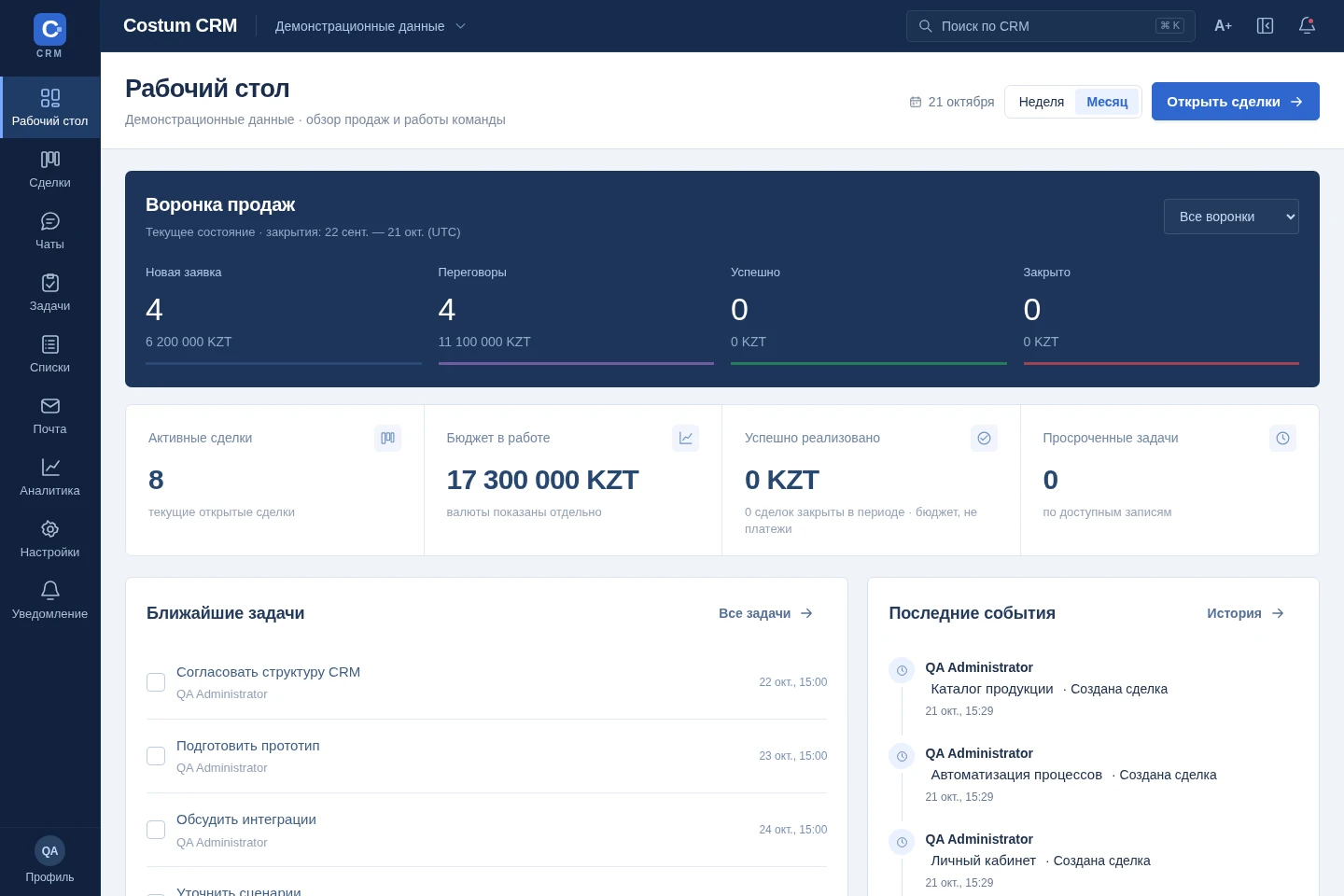
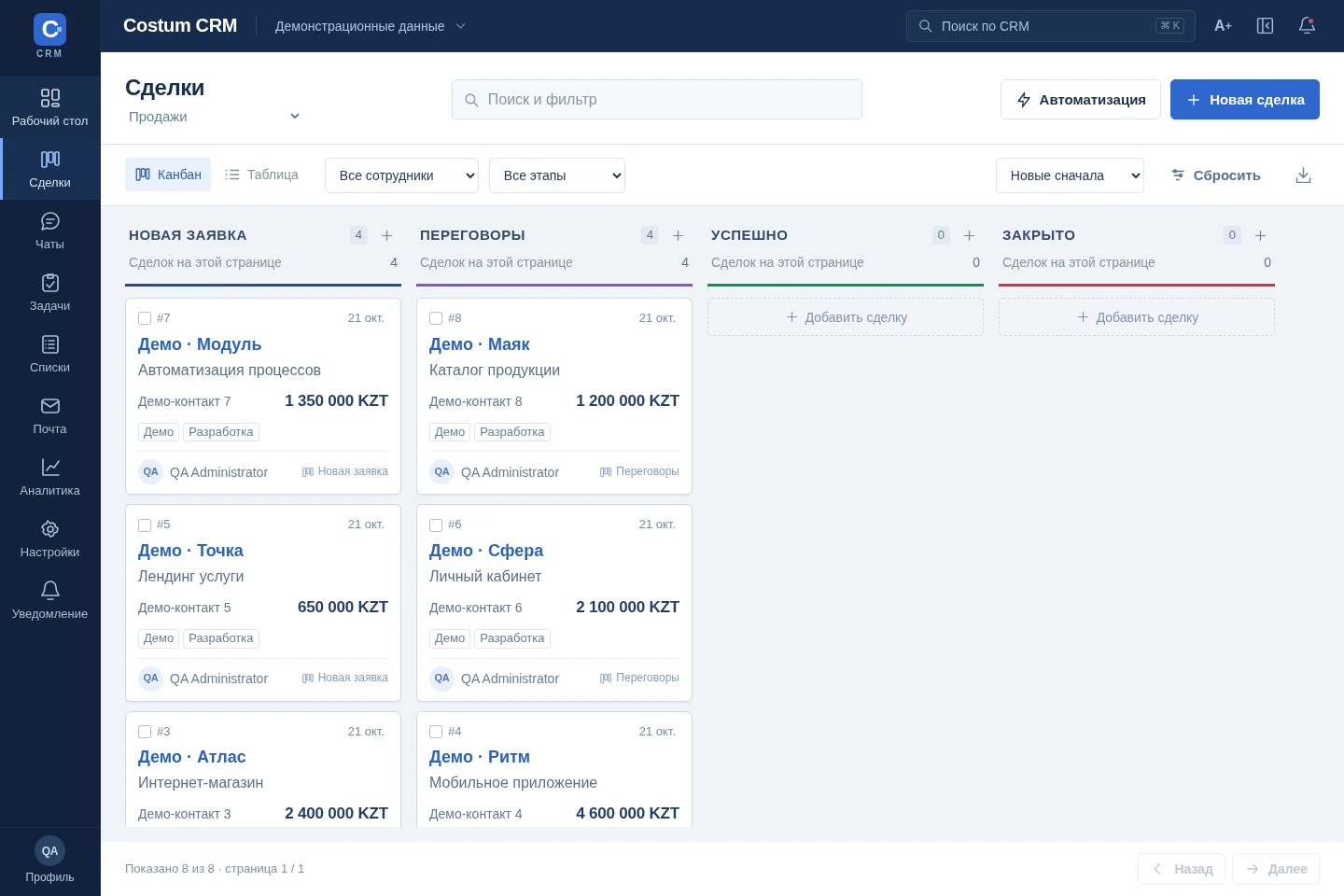
A custom CRM makes sense when configuration cannot reliably support an important workflow. Wanting a different interface alone is not a sufficient reason to build and maintain a new system.
A useful brief describes how the business works and what the system must do. A list of clients, deals and reports without scenarios cannot establish a shared project scope.
A CRM MVP is a working release that tests a specific process, not a collection of unrelated screens. It should let a user complete a task from beginning to outcome within clear limits.
Design permissions around working responsibilities rather than job titles. A person may perform several functions, but each granted capability needs a clear business reason.
Migration is more than uploading a customer spreadsheet. Preserve links among people, companies, deals, tasks and documents, and explicitly agree which historic records do not belong in the new system.
A reliable integration is defined by its response to retries, delays and outages, not one successful request. Agree which system owns each kind of data before implementation.
The first-release estimate is not the total cost of a CRM. Separate system creation, ongoing operation and post-launch changes to make an informed comparison.
Acceptance should demonstrate that agreed business tasks work. A tour of attractive screens does not replace testing workflows, exceptions and operational readiness.
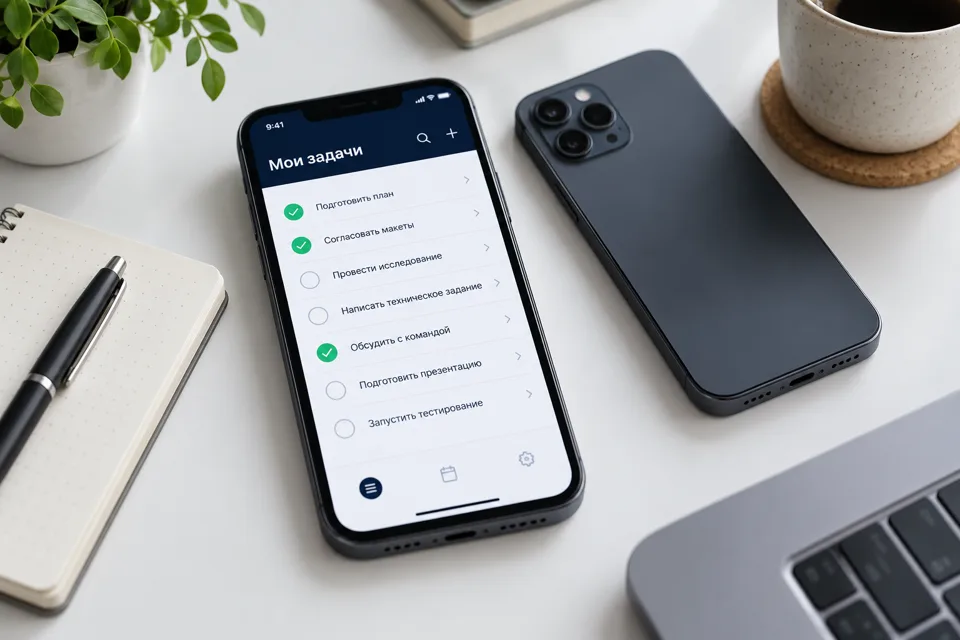
Choose an application format from its usage context, not a preferred technology. Frequency of use, target devices, connectivity and required phone capabilities determine the fit.
Build the first release around one repeatable user action. If the core task still requires a phone call or manual data transfer, the MVP does not yet test the complete product.
Offline support is a separate workflow rather than a settings switch. Define what users can read or change without connectivity and what may be shown before the server confirms it.
A finished build is not the same as a publication-ready app. Prepare accounts, data disclosures and support processes so launch does not depend on one developer’s personal access.
A useful brief describes a buying decision rather than a button colour. It aligns page content, implementation scope and the way the finished landing page will be checked.
The order of sections should help someone make a decision. An attractive opening screen cannot replace a clear explanation of the service, its terms and the next step.
Analytics should support decisions about the page and its acquisition channels. Start with a small event set whose meaning is shared by marketing and sales.
A small business website lets someone verify a company and decide whether its service fits. A compact format still needs to answer practical customer questions.
Multilingual delivery means more than translating navigation. Every version should solve the same visitor problem and remain connected to its corresponding pages.
Checkout should clearly answer what is being bought, the final cost and how it will arrive. Uncertainty matters more than adding another decorative section.
A store-to-warehouse integration needs rules for data ownership. A successful API response alone does not prove that shoppers are seeing available stock.
Launching a store means checking a connected journey from product discovery to fulfilment. Testing the homepage alone does not demonstrate trading readiness.
A performance budget sets limits before heavy implementation choices accumulate. It helps prevent a new image or widget from degrading the entire user journey.
Search preparation starts before publication. Its purpose is to provide useful pages for people and clear access to the versions that should be indexed.
A CRM system helps businesses in Kazakhstan stop losing leads, control customer requests, automate sales and see clear analytics for every manager, advertising channel and deal stage. KazitLearn implements Kommo, chatbots and sales automation for small and medium-sized businesses.
Businesses in Kazakhstan are increasingly implementing AI bots to automate sales and improve customer communication. Artificial intelligence helps companies respond to leads instantly, qualify prospects, reduce managers’ workload, and significantly increase conversion rates. Integration with Kommo CRM creates an efficient and fully automated sales funnel.
In 2026, artificial intelligence is no longer just a tool for developers — AI can now write code, build websites, create mobile applications, and automate CRM systems. Businesses in Kazakhstan and worldwide are asking the same question: will AI replace programmers completely? In this article, we explore how Codex AI and modern automation technologies are reshaping the future of software development.
Artificial intelligence is transforming the way businesses manage sales and customer communication. By integrating AI with CRM systems, companies can automate lead processing, customer responses, and sales workflows without relying entirely on human managers. For businesses in Kazakhstan, AI CRM solutions offer a powerful way to reduce costs and improve efficiency.