iOS application development
iOS applications designed around user journeys and platform constraints, from prototypes through release builds and maintenance.
Explore →Mobile applications for recurring customer and employee tasks, backed by appropriate APIs, integrations and a clear development plan.
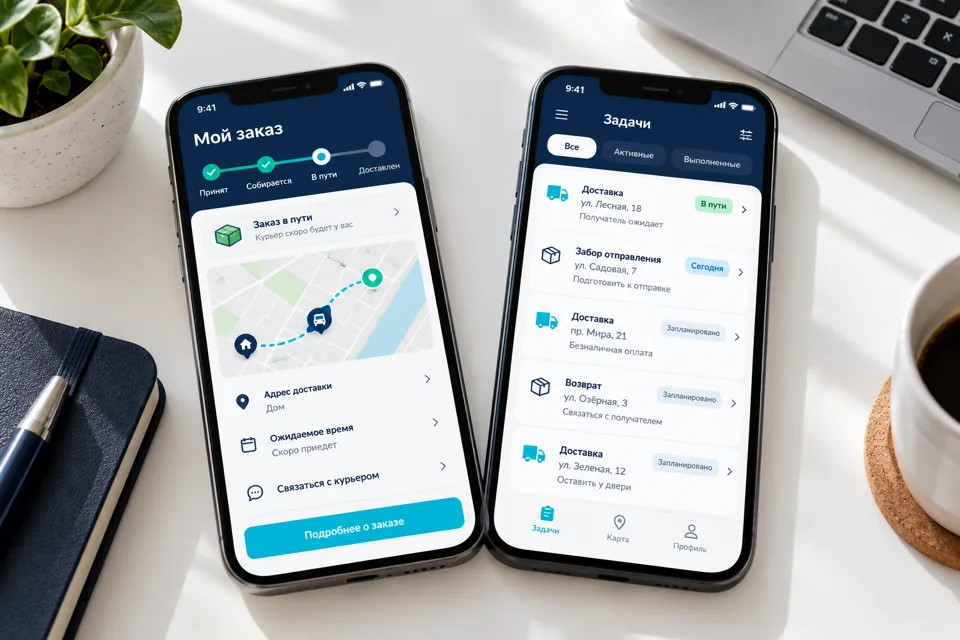 Illustrative image
iOS applications designed around user journeys and platform constraints, from prototypes through release builds and maintenance.
Explore →Android applications for customer services and business work, designed for actual devices, network conditions and distribution requirements.
Explore →Applications that let customers complete recurring tasks independently while staying connected to your operational systems.
Explore →Put necessary work tasks on an employee’s phone while preserving clear permissions, statuses and operational responsibility.
Explore →Connect drivers, couriers and dispatchers with orders, relevant route information and verifiable delivery outcomes.
Explore →Help sales staff and representatives work with products and orders on mobile devices while staying consistent with the core inventory system.
Explore →An app can support repeat orders, field work, delivery confirmation or stock enquiries. Define the recurring task and the device capabilities it needs: camera, notifications, location, local storage or unreliable-network support. An app-store listing is not a business objective by itself.
Compare a responsive website, PWA and application before choosing. Distribution, platform limits, target devices and maintenance capability matter alongside initial build cost. Native and cross-platform approaches are evaluated against actual journeys.
The agreed scope includes prototypes, interfaces, authentication, APIs and necessary administrative operations. Design first launch, empty data, expired sessions, denied permissions and connection failures as well as populated screens. Offline capabilities need explicit local-data and synchronisation rules.
Agree ownership of developer accounts and infrastructure. Release preparation includes a build, descriptions, imagery and privacy information. Store acceptance remains a platform decision and cannot be guaranteed.
Every camera, location or notification permission needs a clear purpose. Minimise personal data and enforce access on the server. External-service secrets do not belong in public builds. Agree retention, account deletion and access revocation.
Check CRM, ERP and payment APIs before committing to an integration. Retried requests must not duplicate orders. Background execution depends on iOS and Android rules rather than promises in a prototype.
Apps and servers do not update simultaneously. Agree API compatibility, oldest supported builds and upgrade messaging. New required fields must not unexpectedly break installed versions. Test upgrades from the previous release as well as clean installation on an empty device.
Choose one complete initial journey and target devices. Prototype, implement and test the app and exchange, then run a pilot. Define error monitoring, dependency updates and urgent-fix responsibilities before release.
That depends on the audience and work devices. A single-platform pilot can be sensible if future differences are planned.
Journeys, platforms, backend work, integrations, offline behaviour and maintenance requirements. Scope and acceptance come before an estimate.
Selected actions can be supported locally when designed explicitly. Available data and synchronisation conflicts need separate rules.
Message us on WhatsApp: we will review your pipeline, lead sources, integrations and implementation stages without fake guarantees.
Tell us which process needs to improve. We’ll discuss the approach, the first version and the next steps.