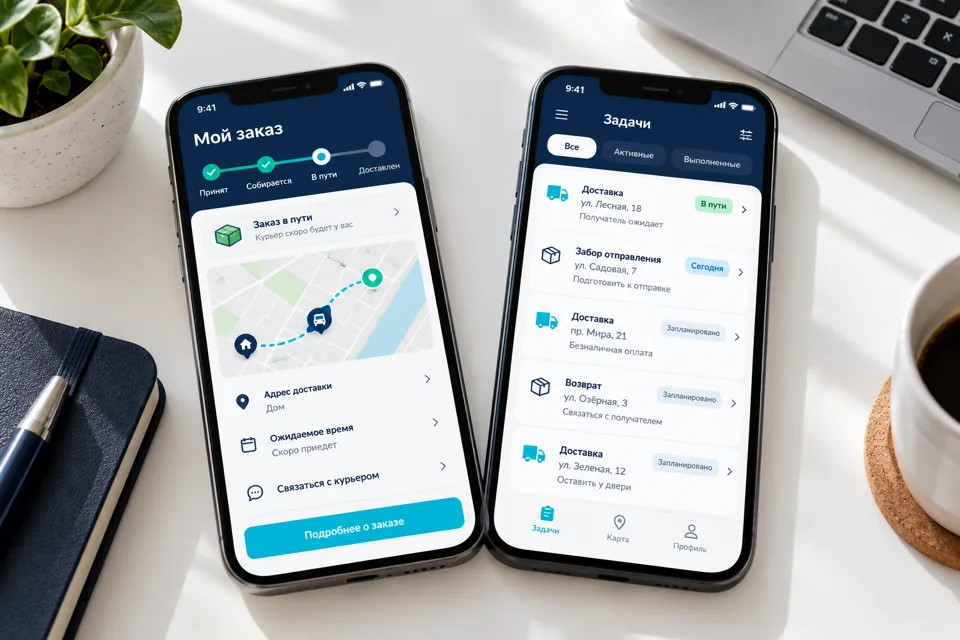
 Illustrative image
Define the supported device fleet
Android spans phones, tablets and specialised terminals with different versions, memory, screens and background restrictions. Scope begins with actual devices and operating conditions. A customer’s personal phone and a company-issued terminal need different distribution and support approaches.
Agree minimum versions, device capabilities and weak-network journeys. Barcode scanners, NFC and printers require model-specific documentation and testing. Android alone does not imply compatibility with every accessory.
Design operational and offline states
Build navigation, accounts, forms, operations and notifications within the agreed scope. Include loading, empty, error and retry states. Essential actions should not depend on a hidden gesture; hardware buttons may require separate support.
For offline documents, distinguish drafts, pending submissions and server-confirmed results. Agree conflict handling, retries and cache limits. Keeping a screen in memory is not full offline capability.
Permissions, updates and APIs
Request camera, location, files and notifications only for specific tasks. Test permission denial and revocation across supported versions. Power-saving rules can constrain background execution; continuous work cannot simply be promised.
The API enforces permissions independently of the interface. CRM and ERP exchanges need test access, a data model and retry rules. Secrets stay out of public builds. Corporate device-management requirements are agreed with the owner.
Updates must preserve local drafts when database fields change. Test migration and recovery after a failed upgrade, with useful diagnostics that avoid unnecessary personal data. Fleet rollout should be coordinated so a working shift is not left without a compatible application.
Pilot and acceptance
After prototyping, test a working journey on selected hardware. Emulators do not verify scanners, cameras, peripherals or power-saving behaviour. Agree store or permitted corporate distribution, release signing and update responsibilities.
- Core work passes on supported models.
- Network retries do not create duplicates.
- Permission changes do not lose work.
- Updates preserve data according to agreed rules.
- Peripherals pass real device tests.
Project questions
Will it support every Android device?
That is not a responsible promise. Supported versions, models or capabilities and a test matrix must be defined.
Can an industrial scanner be connected?
Where the model has a documented integration method. We need test hardware and the actual workflow.
Is Google Play mandatory for company apps?
Not always. A permitted corporate channel may be appropriate, subject to device ownership and update requirements.