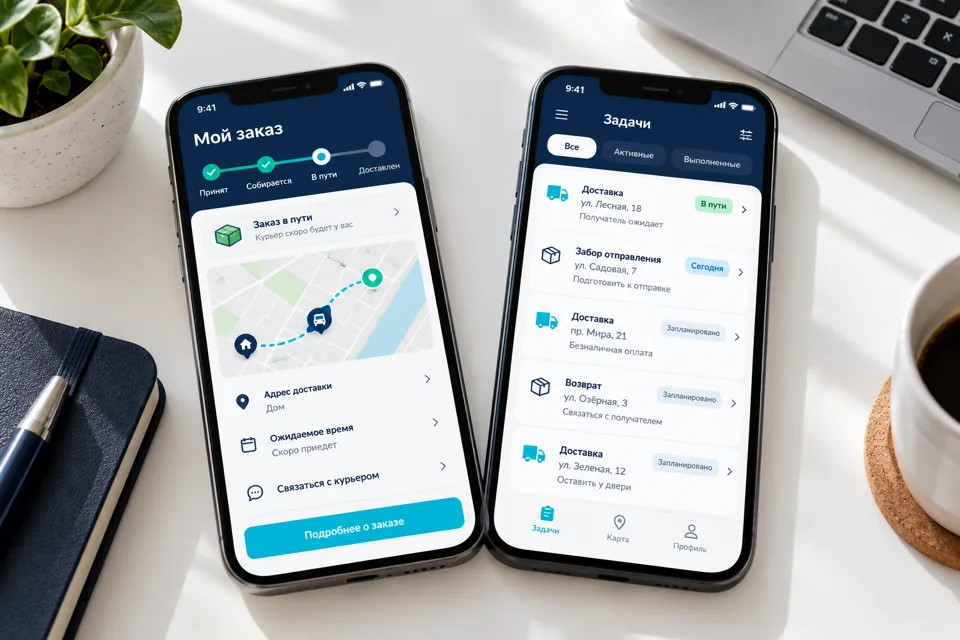
 Illustrative image
Model the delivery workflow
A map alone does not explain what happened. Define assignment, arrival, handover, refusal, failed delivery and return, including who may change each state and why. Otherwise the office and driver develop competing records.
Separate planned routes, actual visiting order and confirmed operations. Resequencing may require permission. Give drivers only the recipient details, address and time-window information necessary for the task.
Support work on the route
Scope may include assignments, delivery cards, maps or navigation handoff, dispatcher contact, scanning, photographs and confirmation. An on-screen signature or image is not automatically a legally significant document. Its intended status must be agreed.
Partial delivery and returns need item-level rules and warehouse follow-up. Choose offline data and permitted local actions explicitly. Pending submissions must differ from server confirmations, and synchronisation must not repeat stock operations.
Maps, location and external systems
Review map-provider availability, licensing, quotas and costs. Showing a map is not route optimisation: vehicle constraints, service times and delivery windows require a separate model.
Phone location may be inaccurate or unavailable. Background execution depends on platform rules. Do not promise uninterrupted tracking without validation. TMS, ERP and warehouse integration need order identifiers, ownership and error-handling rules.
End-of-shift reconciliation should expose unsent and disputed operations. Where relevant, preserve action time separately from server receipt time. Late synchronisation must not silently rewrite an earlier order; dispatchers need to identify duplicates, partial handovers and missing evidence.
Pilot and acceptance
Start with one role, delivery type and device set. Include failed delivery, reassignment and network loss in the pilot. Agree shift support and lost or discharged-device procedures.
- Delivery states follow approved transitions.
- Retries do not duplicate confirmation or stock movement.
- A workflow exists without GPS.
- Partial handover and returns reconcile across systems.
- Dispatchers can handle pending and failed operations.
Project questions
Is route optimisation included?
It is a separate task requiring vehicle constraints, time windows, stop data and an appropriate calculation service.
Can photos confirm delivery?
Where storage, access and operating rules are agreed. Their legal or evidential status is not assumed automatically.
Can dispatch see a driver without connectivity?
Not in real time. Permitted events can be recorded locally and uploaded later, which is not continuous live tracking.