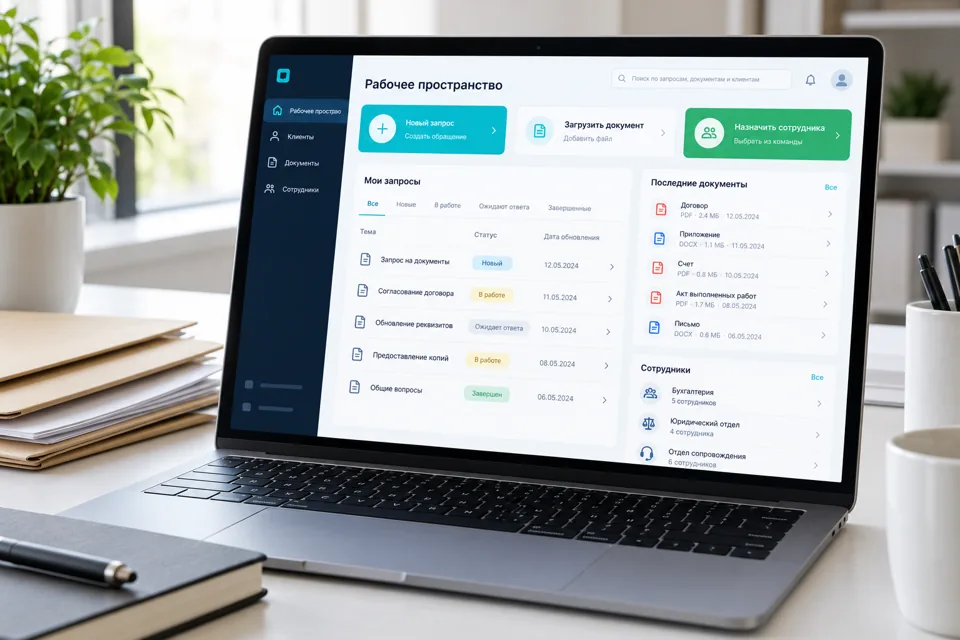
Business systems built around your operations

When CRM, spreadsheets and accounting tools no longer work together, another isolated application may not help. KazitLearn develops business systems around staff responsibilities, authoritative data sources and existing infrastructure constraints.

Service illustration: Business systems built around your operations Illustrative image

Choose your use case

Choose the right operating scope

ERP connects resources and accounting, service management tracks requests and work, HR supports employee processes, and document systems manage versions and approvals. If the issue is only data transfer, an integration may be sufficient. Bespoke development should close a meaningful gap left by standard products.

Identify process and data ownership

Discovery maps participants, records, statuses and exception paths such as cancellation, return and reassignment. Each customer, product, contract or employee needs an authoritative source. Reports, imports and supplier dependencies are specified separately. The first deliverable is an agreed process map and initial scope rather than a promise to automate everything.

Deliver useful working modules

The scope can include reference data, operational journals, staff workspaces, approval routes and explainable reports. Role and department access, change history, search and export are designed around actual tasks. A user should understand available actions, while a manager can trace a reported figure to its source.

Control access and integration constraints

Before importing production records, agree retention, deletion, backups and contractor access. Personal data serves defined purposes with least-privilege permissions. Check external API capabilities, licences and request limits. Legal and organisational obligations require separate assessment; installing software does not establish compliance.

Roll out in controlled stages

Test a prototype with the staff who perform the operation, then launch a limited scope and reconcile migrated records. Training covers normal tasks and recovery from mistakes. Agree transition criteria and a rollback procedure before retiring an existing application.

Accept completed operations

Requirements describe input and expected outcomes, including edits, cancellation, reporting and cross-role access. Code ownership, deployment and support responsibilities are agreed before delivery. Handover includes the agreed source, configuration and operating instructions.

  • Owners and valid status changes are documented.
  • Imports reconcile with source records.
  • Forbidden actions are tested.
  • A backup has been restored in a test environment.

Project questions

Must every existing application be replaced?

No. Retaining working applications and replacing one problematic area is often the better approach. A staged design exposes limits before a large migration.

How is this different from CRM?

CRM focuses on customers and sales. A business system may also cover resources, service, employees and documents, with CRM as one component.

Who owns the data?

Data and code ownership, export formats and infrastructure access are agreed beforehand. Handover should not depend on a single employee or contractor.

KazitLearn

Need a similar CRM workflow for your business?

Message us on WhatsApp: we will review your pipeline, lead sources, integrations and implementation stages without fake guarantees.

Let’s start with your challenge.

Tell us which process needs to improve. We’ll discuss the approach, the first version and the next steps.

By submitting, you agree to our privacy policy.

WhatsApp request