 Illustrative image
Make tasks actionable at the workstation
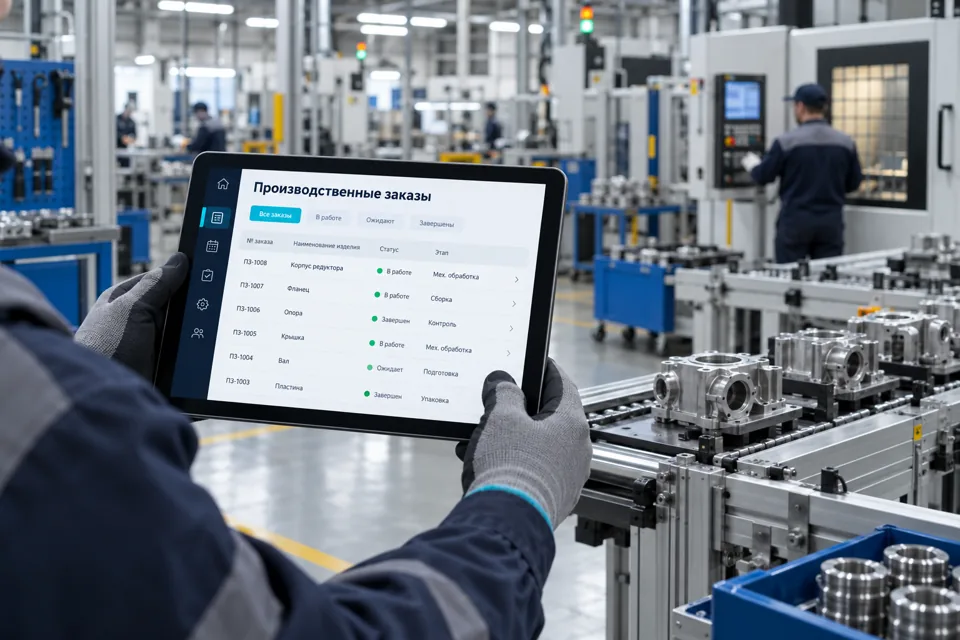
Review shift start with a supervisor: which orders are ready and which lack material, tooling or a preceding operation. Show drawings, instruction versions, quantities and priority where needed. Distinguish released tasks from provisional plans. Shared terminals require operator identification; test usability with actual gloves, noise and time constraints.
Record execution and exceptions
Capture starts, pauses, partial output, completion, scrap reasons and transfers. Agree what operators enter, supervisors approve and devices supply. Mistaken actions need a correction path and audit history. When several people share an operation, define labour and output units so one completion is not counted repeatedly.
Schedule without unsupported certainty
A workload board needs calendars, resource availability and dependencies. Manual assignment, conflict checks and queue suggestions are possible. Do not promise optimal schedules without reliable standards. Keep planned durations separate from observations and show rescheduling reasons. Define who can reprioritise urgent orders and how released-task changes reach other users.
Devices, connectivity and safety boundaries
Browser terminals, tablets and Windows stations must be tested on site. Intermittent networks need a durable queue and visible pending actions. Scanners and gateways require actual model and protocol checks. Operational software does not replace safety PLCs, protective interlocks or emergency stops; machine-command functions need a separate engineering assessment.
Pilot with a complete shift
Prototype a short route, agree reason codes and connect tasks to ERP or production accounting. Test role workflows, connection loss, correction and peak terminal usage. Document shift start, unfinished-task handover and support. Agree source-code and operating-account ownership.
- Block unauthorised route completion.
- Retain remaining quantity after partial work.
- Prevent duplicate output on retries.
- Identify correction authors.
- Preserve unfinished tasks at handover.
Project questions
Is this a complete MES?
A shop-floor application may cover a defined execution area. Planning, quality, traceability and wider integration require separately agreed MES scope.
Can operators share a terminal?
Yes, with agreed identification, user switching and action permissions tested in the actual workplace.
Must every machine event be collected automatically?
No. Confirmed manual entries can support an initial release. Automatic capture requires technical verification and a clear meaning for each signal.